Our History
The Austrian Patent Office has been protecting innovations in Austria since 1899. Discover the history of an organization that always keeps pace with the times

From handwritten historical patents during the imperial era to 100% digital applications: The Austrian Patent Office has been supporting people with ideas since 1899. A look back at our history reveals what has changed during this time, and what has remained the same.
Up to 1899: Historical patents – known as “privileges”
Our collection of historical patents contains amazing inventions dating from 1852 to 1899, such as the folding bicycle from 1896 by inventor and bicycle manufacturer Johann Puch. Historical patents were granted by the emperor at that time and, just like patents today, were a type of monopoly on the use of inventions. Our library’s unique historical collection comprises around 95,000 documents – some handwritten and with beautifully colored drawings. They can also be accessed online at privilegien.patentamt.at.
![[Translate to English:] Bild eines Privilegs von 1896, das die schematische Zeichnung eines faltbaren Fahrrads von Johann Puch zeigt.](/fileadmin/_processed_/9/7/csm_bis1899_faltrad_697e96daee.png)
1899: How it all began
On January 2, 1899, the Austrian newspaper Neue Freie Presse reports on the founding of the Imperial and Royal Patent Office at Siebensterngasse 14 in Vienna’s 7th district. The opening took place “without any ceremony” – and the welcome address to the new staff by the Minister of Commerce, Baron von Dipauli, had to be postponed because the minister “had not yet fully recovered from his bout of influenza.”
![[Translate to English:] Zeichnung des Gebäudes in der Wiener Siebensterngasse, in dem das Patentamt ab 1899 seinen Sitz hatte.](/fileadmin/_processed_/7/1/csm_1899_haus_patentamt_e2e5e19704.png)
1908: From Paris to Madrid
In 1908, Austria joins the Paris Convention for the Protection of Industrial Property and the Madrid Agreement Concerning the Registration of Marks. That same year, the two trademarks “Fritze Lacke” and “Sidol” are filed – and remain registered as valid word and figurative marks to this day.
![[Translate to English:] Auszug aus den Markenregistern für "Fritze Lacke und "Sidol"](/fileadmin/Patentamt/Fotos/Geschichte/1908_Marken.png)
1920s: The Roaring Twenties
A “wind of change” sweeps through Austria, leaving its mark even in Vienna’s government offices. As a result, on the patent certificates of the First Republic, the double-headed eagle representing the monarchy is replaced by an image of the Parliament. And in 1926, the Patent Office moves to the government building at Stubenring 1, where there is also ample space for the ever-growing specialist library.
![[Translate to English:] Patenturkunde aus der Ersten Republik](/fileadmin/_processed_/6/4/csm_H01_Patenturkunde_1Rep_58bedc1fb0.jpg)
1938: “Never again”
After the National Socialists seize power in 1938, the Austrian Patent Office becomes a branch of the German Reichspatentamt. Just a few days later, the acting president, Johann Werner, is replaced by a Nazi Party member. Nine civil servants immediately lose their jobs. Three employees – Stefan Jellinek, Paul Karplus, and Heinrich Lichtblau – are murdered in the Holocaust.
![[Translate to English:] Eine Patentschrift des Deutschen Reichs aus dem Jahr 1938](/fileadmin/_processed_/0/1/csm_1938_patentschrift_6af8cf13b8.png)
1944: Library collection moved to Retz
To protect it from bombing raids, the Patent Office library is relocated in 1944 to a wine cellar in Retz, Lower Austria. There the books are safe from the ravages of war, but not from moisture: a large portion of the collection falls victim to mold.
![[Translate to English:] Schwarzweißfotografie eines Hauses in Retz im Jahr 1944](/fileadmin/_processed_/0/9/csm_1940_Retz_e14d2e9fa4.png)
1945: A new beginning
After World War II, the Patent Office moves into a historic building on Vienna’s Kohlmarkt. A large portion of the staff had Nazi ties, which meant that only one of the eight lawyers and only 22 of the 70 technicians could be retained in the reestablished institution. The Austrian Patent Office begins accepting applications again on August 13, 1945.
![[Translate to English:] Schwarzweißfoto des Wiener Kohlmarkts in den 1940er Jahren](/fileadmin/Patentamt/Fotos/Geschichte/1945_kohlmarkt.png)
1950s: The economic miracle
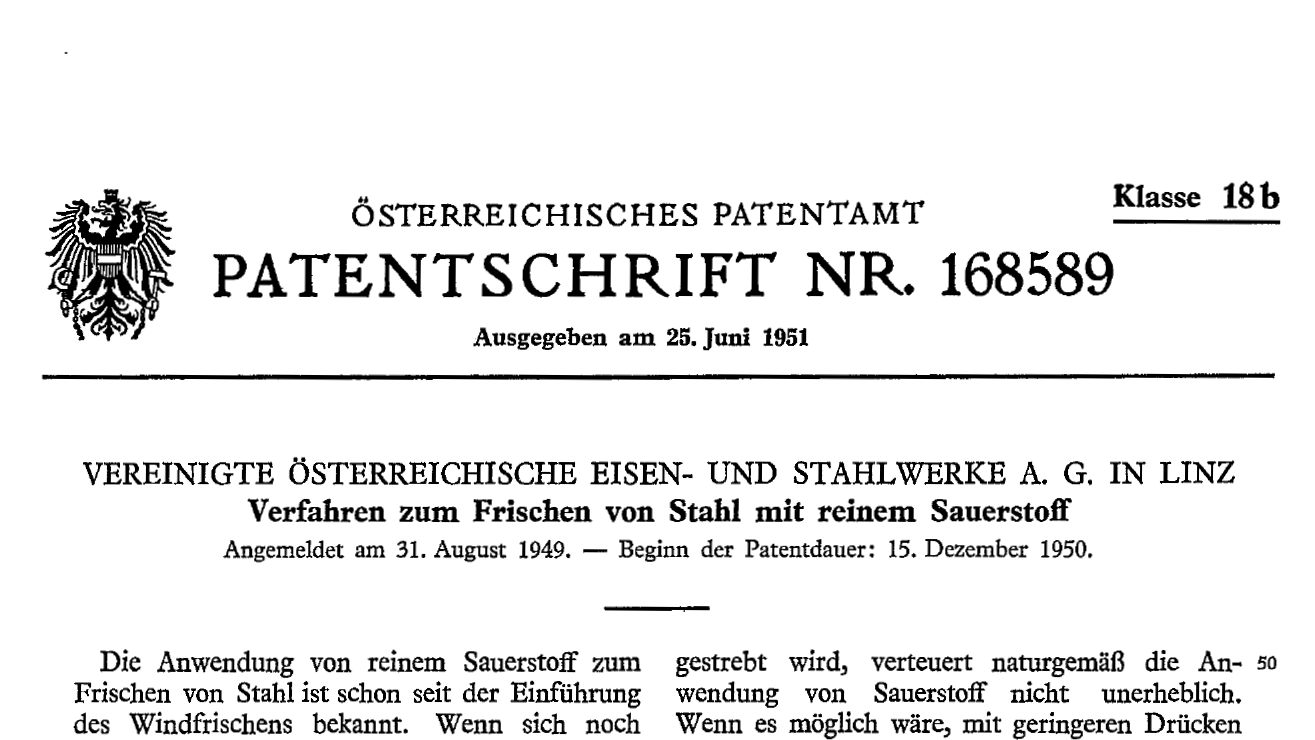
Patent applications nearly double in the 1950s, yielding important innovations such as VOEST’s Linz-Donawitz process and the birth control pill developed by the Viennese chemist Carl Djerassi. The former revolutionizes steel production, the latter sexual life – worldwide. A growing concern for policymakers is that an increasing number of applications are coming from abroad, while domestic filings stagnate. This only changes with more active research funding from the 1960s onwards.
1960s: The Swinging Sixties
The hippie movement and Woodstock pass by the Patent Office almost unnoticed, while national patent applications reach an all-time high of 12,732 in 1968. Extensive renovations and expansions are carried out to create more space for the Patent Office. Additional premises are rented on Habsburgergasse. In the Imperial Palace, the baroque private rooms of Franz Stephan of Lorraine, the husband of Empress Maria Theresa, are available for events.
![[Translate to English:] Schwarzweißfoto von der Renovierung der Kaiserräume im alten Gebäude des Patentamts](/fileadmin/_processed_/c/d/csm_H03_Kaiserraeume_Renovierung_6861c5b609.jpg)
1977: Munich becomes a hub
In Munich, the price of a liter of beer at the Oktoberfest rises to DM 4.25 in 1977. Just three kilometers from the Theresienwiese where the festival is held, the European Patent Office opens its doors. Austria would soon ratify the European Patent Convention as well.
![[Translate to English:] Foto eines vollen Bierkrugs](/fileadmin/_processed_/2/b/csm_1970_Bierkrug_engin-akyurt-unsplash_44a8b260b5.jpg)
1979: International patent protection becomes easier
In 1979, Austria joins the European Patent Convention (EPC) and the Patent Cooperation Treaty (PCT) of the World Intellectual Property Organization (WIPO). Today, the treaty facilitates patent applications in over 150 countries. The image shows Otto Leberl, then President of the Austrian Patent Office, at the Meeting of the Administrative Bodies of WIPO in 1979.
![[Translate to English:] Foto von der Tagung der Verwaltungsorgane der WIPO mit Präsident Otto Leberl, 1979](/fileadmin/_processed_/a/a/csm_1979_9d613e6b41.png)
1999: A century of protecting ideas
To mark the 100th anniversary of the Austrian Patent Office in 1999, all employees are invited to a celebration. At the same time, a commemorative stamp is issued by the Austrian Post. Austrian Federal President Thomas Klestil also joins in the celebrations. In the same year, a comprehensive amendment to trademark law leads to harmonization with the European and international trademark protection systems.
![[Translate to English:] Links: Bundespräsident Thomas Klestil bei der 100-Jahre-Feier; rechts: Briefmarke zum Jubiläum](/fileadmin/Patentamt/Fotos/Geschichte/100.png)
2003: New address Dresdner Strasse 87
The Patent Office moves from Kohlmarkt to Dresdner Strasse in Vienna-Brigittenau. The Austrian daily newspaper Der Standard runs the headline: “Patent Office Moves to the Outskirts.” The new offices offer less imperial flair, but a more modern setup and lower rent instead. A total of 32,000 boxes have to be transported to Dresdner Strasse; the library alone contains around 40 million patent documents.
2011: Online applications on the rise
The age of digitization reaches patent applications. The first patent to be filed online in 2011 is a “gear for a backlash-free spur gear stage” by MIBA Sinter Austria GmbH.
![[Translate to English:] Foto einer alten Schreibmaschine neben einem neuen Laptop](/fileadmin/Patentamt/Fotos/Geschichte/2011_Schreibmaschine_Laptop_glenn-carstens-peters-1unsplash.jpg)
2015: A woman at the helm
In 2015, Mariana Karepova becomes the first woman to serve as president of the Austrian Patent Office. Under her leadership, the venerable agency transforms into a modern service provider that offers its entire range of services online. (Photo: APA Fotoservice/Reither)
![[Translate to English:] Foto von Mariana Karepova](/fileadmin/_processed_/b/4/csm_MarianaKarepova_Fotocredit_APA_Fotoservice_Reither_fbe0d2886f.jpg "Brands Pop Up by Patentamt")
2016: Premiere for the National Award for Patents
In 2016, the National Award for Patents is presented for the first time. It has since been awarded every two years in the categories of patents, trademarks, and a special category. The trophies are presented by the Ministry of Innovation and the Patent Office at a special ceremony. (Photo: Christian Husar)
![[Translate to English:] Foto von allen Siegerinnen und Siegern auf der Bühne bei der ersten Verleihung des Staatspreises Patent](/fileadmin/_processed_/7/b/csm_Staatspreis2016_12060dc7ca.jpg)
2018: Learn from the pros
The Patent Office’s IP Academy is founded in 2018 offering training for beginners and professionals alike in all matters relating to patents, trademarks, and designs. The workshops on offer range from the basics to special topics, such as “Can I patent my software?” or “Is there a patent on life?”.
![[Translate to English:] Foto von einer Streaming-Diskussionsveranstaltung der IP-Academy](/fileadmin/Patentamt/Fotos/Geschichte/2018_IPAcademy.png)
2019: We are 100% digital
In 2019, the Patent Office begins to offer its full range of services 100% digitally. Customers can submit all applications – whether for patents, trademarks, or designs – using online forms. The last fax message reaches us shortly before the end of the year.
![[Translate to English:] Scan der letzten Fax-Sendung an das Patentamt aus dem Jahr 2019](/fileadmin/_processed_/f/0/csm_2019_digital_5bad8d25e6.png)
2023: Boundless exchange
Exchange with other patent offices and international institutions has been an integral part of our work for many decades. A significant milestone following decades of negotiations was the introduction of the unitary patent on June 1, 2023. Eighteen European countries have been participating in it since September 2024. This saves patent applicants a lot of paper, time, and money as only a single renewal fee is charged for all participating states, not per country, as before.
![[Translate to English:] Europakarte, bei der die 18 Länder eingezeichnet sind, in denen seit 2023 das Einheitspatent gilt](/fileadmin/_processed_/e/a/csm_H32_Einheitspatent_eba9d8040b.jpg)
Book on the history of the Austrian Patent Office
The book “Behörde. Wissensspeicher. Serviceeinrichtung. Das Österreichische Patentamt 1899–2024” has been published by StudienVerlag and is available in specialist bookstores (ISBN 978-3-7065-6423-6). In it Maria Wirth and Alexander Pinwinkler from the Association for the Scientific Study of Contemporary History at the Institute of Contemporary History at the University of Vienna shed light on the development of the Patent Office from the imperial era to the present. They also examine in detail the Office’s darkest era – National Socialism and its effects.
You can download a free digital version of the publication here: